Let’s face it, some of us are not networking naturals. It might feel awkward, disingenuous, or simply unsafe. But if you’ve recently lost your job, the best time to have a strong, strategic network of contacts was probably yesterday.
“Strategic” is the operative word. Networking should not be throwing yourself into happy hours, conferences or virtual events and hoping for the best.
Start With Your Inner Circle
Thinking about your network in layers of “Concentric Circles.” In your inner circle, check in with close colleagues who will remind you of your talents and unique contributions. Look to your family or friends to encourage you and build you up after a bad interview or celebrate after a good one. Then, tap into your “Secondary Network”, those people whom you know, but not as well.
Statistically,your next opportunity typically emerges from your secondary or tertiary network because they are made up of people who have access to information you and your primary network do not have access to. So, reach out to the colleague you worked with a few years ago, and reconnect with the neighbor you have not spoken with recently. Ask for input and help.
Be Specific
It never hurts to be specific when you are asking for help. In fact, it is key in inspiring your network to work with you. Just remember that in networking, life rewards the specific and punishes the vague.
Be clear about your expected outcomes and what you want to do. It will not only help your networks put you in touch with the right people, but it also expedites the time of your desired outcomes.
Success does not need to be synonymous with chronic overwork.
Introduction
In recent years, the term “Hustle Culture” has become synonymous with the belief that working tirelessly, loading up on caffeine, and depriving oneself of sleep is the sure-fire path to success. This all-encompassing work ethos has permeated our society, with many individuals buying into the notion that success hinges on a constant state of busyness. However, it is essential to examine the downfalls of such a culture, as it can take a toll on both mental and physical well-being and, ironically, lead to diminished chances of achieving long-term success.
The Allure of the “Hustle Culture”
The hustle culture is often marketed as a path to greatness. Proponents argue that to achieve success, one must commit fully, often to the detriment of their personal lives and well-being. This approach suggests that those who work longer hours, neglect leisure time, and sacrifice sleep will be more likely to reach their goals. In this context, caffeine consumption is encouraged as a means of staying awake and productive, despite the toll it can take on one’s health.
The Downfalls of the “Hustle Culture”
Burnout: One of the most significant downfalls of hustle culture is the heightened risk of burnout. Continuous stress, long hours, and inadequate self-care can lead to emotional and physical exhaustion. Burnout can result in decreased productivity, impaired decision-making, and a loss of motivation, ultimately derailing the pursuit of success.
Diminished Creativity: Overwork and a lack of rest can stifle creativity. Creativity often thrives in moments of leisure, relaxation, and daydreaming. A culture that prioritizes unrelenting work can hamper the very innovation and fresh thinking necessary for long-term success.
Declining Health: The physical toll of hustle culture is undeniable. Sleep deprivation and excessive caffeine consumption can lead to a range of health issues, including weakened immune systems, cardiovascular problems, and mental health disorders like anxiety and depression. In the long run, these health issues can hinder rather than enhance one’s path to success.
Neglected Relationships: An intense focus on work often leads to the neglect of personal relationships, causing strain on family, friendships, and even romantic partnerships. Neglected relationships can lead to feelings of loneliness and isolation, potentially impeding one’s overall sense of well-being and fulfillment.
Short-Term Gains, Long-Term Losses: While it might appear that hustling hard in the short-term yields results, it is unsustainable in the long run. Many people who live by this culture risk experiencing “success” that comes at the expense of their health, happiness, and overall quality of life. Success that is achieved through a balanced approach is not only more sustainable but also more fulfilling.
A More Balanced Approach to Success
Success does not need to be synonymous with chronic overwork. A more balanced approach involves setting clear boundaries, prioritizing self-care, and recognizing that sustainable success takes time and patience. It is about finding the equilibrium between work and personal life, allowing for creativity to flourish, maintaining health and well-being, and nurturing relationships. Success is not merely about working harder; it is about working smarter and creating a life that is meaningful and fulfilling.
Conclusion
The “Hustle Culture” may promise success through ceaseless work and self-sacrifice, but it often delivers the opposite. Burnout, declining health, and neglected relationships can ultimately hinder the pursuit of long-term success. Instead, a more balanced approach to success is essential, one that values well-being, creativity, and sustainable achievement. By focusing on a more holistic view of success, we can achieve not just our professional goals but also lead happier, healthier, and more fulfilling lives.
We owe it to humanity to see the rules of war are observed, no matter how tough a test the Israel-Hamas conflict proves. No set of crimes justifies another. To succumb to this principle would mean a never-ending cycle of violence.
For almost 4,000 years, most governments have insisted that if wars must be fought, there should be rules. The first known code, by the Babylonian king Hammurabi, laid down the principle on which all subsequent laws of war have been based: “To Prevent the Strong from Oppressing the Weak”.
During its assault, on Black Saturday, Hamas broke numerous laws of war, starting with its rocket fire into Israel, which made no attempt to discriminate between military and civilian targets, breaking article 13 of protocol II of the Geneva conventions. Its fighters allegedly murdered, tortured, and raped, breaking common article 3 of the Geneva conventions and articles 27 and 32 of the fourth convention. They also allegedly engaged in pillage and terrorism (33, fourth convention) and the taking of hostages (34, fourth, and article 8 of the Rome statute). Though this is harder to prove, these acts might have been motivated by genocidal intent, arguably also putting Hamas in breach of the genocide convention. Any of the people responsible who are captured should be tried for crimes against humanity.
In responding to this attack, Israel has also broken several laws of war. These crimes begin with the use of collective penalties against the people of Gaza (article 33 of the fourth convention and article 4 of protocol II). One aspect of this punishment appears to be the pattern of Israel’s bombing and shelling of Gaza.
“The emphasis is on damage and not on accuracy,” a spokesperson for the Israel Defense Forces announced, which looks to me like stated intent to commit a war crime. The war crime in this case is the damage to property: article 50 of the first Geneva convention, article 51 of the second Geneva convention and article 147 of the fourth Geneva convention. Many of the buildings hit, including numerous schools and health facilities, do not appear to qualify as military targets, despite Israeli claims that Hamas uses people as human shields. Such indiscriminate attacks contravene article 13, protocol II and article 53, fourth convention. The bombing of mosques breaks article 16 of protocol II.
Human Rights Watch claims that Israel has fired white phosphorus shells at Gaza and Lebanon during its counterattack, although this has been denied. White phosphorus munitions can legally be used on battlefields to make smokescreens, mark targets, or burn buildings, but it is considered an indiscriminate and terrible weapon, whose use in such cases might constitute a breach of the chemicals weapon convention.
The Israeli government has admitted cutting off essential supplies to Gaza. On 9 October, the defence minister, Yoav Gallant, stated: “I ordered a full siege on the Gaza Strip. No power, no food, no gas, everything is closed.” This is collective punishment. The energy minister, Israel Katz, appeared to confirm this when he wrote: “No electrical switch will be turned on, no water hydrant will be opened, and no fuel truck will enter until the Israeli abductees are returned home.” The siege also breaches articles 55, 56 and 59 of the fourth convention and article 14 of protocol II, which protects “objects indispensable to the survival of the civilian population”.
While the Israeli government could argue that instructing the people of Gaza City to leave is an attempt to protect them from bombardment, this directive constitute a breach of article 17 of protocol II, forbidding the forced movement of civilians, and of article 49 of the fourth convention on deportations and evacuations. Again, to judge by the statements of some officials, in the siege and attacks on Gaza there could be evidence of genocidal intent. The current fighting, of course, takes place in the context of Israel’s illegal occupation of Palestinian land, and the many subsidiary crimes associated with it.
No set of crimes justifies another
There are no excuses in war or ethics for crimes against humanity. There is never a legal reason to attack one person for the crimes of another, to confuse a people with their government or with the armed forces that claim to defend them, on either side of any conflict. The issue, as always, is enforcement, the most powerful countries customarily refusing to succumb to the rule of law. The laws of war, it seems, are for the little people.
So why bother? Why even mention war crimes, knowing that the charge is unlikely to be enforced against powerful perpetrators? Why not accept that war and atrocity are inextricable?
I will tell you why! Because it is upon these laws that aspects of our humanity hang. If we succumb to cynicism, if we are dissuaded by the hypocrisy of the dominant powers, if we cannot demand and hope for a better world, we accept the premise that might is right, and the powerful may treat the powerless however they wish. Because when we accept atrocities to be perpetuated by one side, this acceptation will be used to justify atrocities by another side, in a never-ending cycle of revenge and carnage.
… and this is exactly what is going on right now and has been happening since 1948 in this perpetual, never ending Palestinian-Israel conflict.
There is life changing magic in a productive story
Are you going to get that promotion? Is your marriage going to make it through a rough patch? Is your company going to hit its projections for the year? The single biggest predictor for all these events is not the facts of your situation, but the story you tell. The bad news is that there is an epidemic of rotten storytelling going on in our culture right now.
The good news is that we can fix that. And the best news is that it is not as hard as you might believe. Small shifts in mindset can trigger a cascade of changes so profound that they test the limits of what seems possible.
The secret is to identify the ideas that trigger a narrative reset, that get your brain out of a negative spiral, and into a productive mindset. Here are five strategies, grounded in science, to help you reset your own narrative.
1. Stop consuming junk stories.
People take in average of 14 newspapers worth of information every day, and most of it is junk. This epidemic of junk storytelling is killing our minds just as surely as junk food is destroying our bodies. The single best thing you can do to reset your narrative is simple: do not take in too much junk.
How can you tell if you have a lot of junk in your storytelling diet?
Junk stories are any kind of story that is designed primarily to rile up your emotions: cable news, most of twitter, lots of clickbait. It is designed to trigger an emotional response. It is addictive, destructive and dangerous. Junk stories tend to create junk thinking, and it is literally bad for our brains.
2. See the river, not the rocks.
When I was first learning to kayak, I kept banging my boat into rocks. I said to my instructor in frustration, “I am hitting every rock on this river!” He said, “Well then, stop looking at them!” This is exactly what I was doing: I was going down the river, staring straight at the things I was most afraid of, and therefore, heading right for them.
We all tend to obsess over the things we are afraid of. The problem is that in life, as on the river, our boat goes where our eyes go. When we read lots of stories, and tell lots of stories, about how bad things are likely to be, we literally make these bad things more likely to happen.
But therein lies the secret to changing this pattern: see the river, not the rocks. Instead of obsessing over all the things that could go wrong, focus on all the things that could go right. Tell stories to your team, your family and in your own head, about everything beautiful that could happen in life.
3. Expect setbacks.
There is a critical corollary to a good mindset: the story you are telling must be true. You cannot deceive yourself with false optimism when the world is falling apart.
To say that you feel positive about the culture in America right now, or to try to convince yourself that everything is going great when your business is faltering, is to deny reality. It creates a form of narrative dissonance: a disconnect between reality and the story we are telling. And it will ultimately break down.
The trick is not to deny suffering, or setbacks, but to accept the setback and the suffering and know that it will pass. Do not tell yourself a story about how easy things are, or how good they are. Tell yourself a story that says: this is all part of the story line. After all, every single success story in history or in literature or in business shares one quality: that moment when the hero needs to decide, against all odds, whether, or not, to keep going.
Teaching low performing people about the growth mindset, the fact that we are all bad at everything before we are good at I, helps improve their performance. Giving new employees students pep talks before they start at their new job, letting them know that struggling during the first year is normal, reduces dropout rates. Telling employees at the start of a project that failure is both inevitable and temporary, will increase the team’s likelihood of success.
4. Tell good stories about the people around you.
Spend some time thinking about the stories you tell about other people because those stories are incredibly important, too. Always look for the best in people. People are not performing the way you want! Meet with every member of your team, asked what they needed from you, and tell them that you believe in them. If their performance is not improving, then, and only then, get rid of them.
For better and for worse, the stories we tell about people tend to become true. When team leaders are cued to think good things about their team members, those team members do better. When people are told, “you are the kind of person who performs well under pressure” before doing a high-stress task, their performance goes up by 33%. Stories change brains, and behaviors.
The lesson here is this: practice telling good stories, even just in your own head, about your spouse and your boss and your colleagues and your clients. You will find that when you change the story you are telling about them, they will change too.
5. Do not plan, just do one thing.
You are overwhelmed with the size and the scope of a problem, and you believe that if you can just write all down, think it all through, you can get a handle on it. But weirdly, the more you think about it, the more stressed out you get. And how often do you find yourself at the end of a long meeting feeling frustrated that nothing has changed? That way of thinking can easily turn into a negative story spiral.
What you need to do is to reset that narrative. When you are feeling overwhelmed, do not plan, do not make, or write down a plan, just do one thing. It literally does not matter what you do. Whenever you act, take any action, it resets the chemicals in your brain from overwhelmed to empowered. Think of the brain as a binary system: you are either frozen in fear or empowered by action. So, if you have a huge to-do list, check off the smallest thing first. Talk to one person, make one call. The chemicals in your brain will change, and so will your story.
In different ways, the sentiment that the Palestinians are collectively responsible for the actions of Hamas in killing of about 1,300 Israelis and abduction of 199, and therefore deserve what is coming to them, has been echoed far beyond Israel’s borders. But the dehumanizing language spilling out of Israel and from some of its supporters abroad is of a type heard at other times and places that helped create a climate in which terrible crimes take place.
For years, Israeli leaders have advocated ethnic cleansing, with a discourse that portrays Palestinians as a fake people with no history that matters. Opinion polls show that significant numbers of Israelis view Arabs as “dirty”, “primitive”, and as not valuing human life. Generations of Israeli school children have been imbued with the idea that Arabs are interlopers and merely tolerated through the beneficence of Israel.
In 1989, Netanyahu lamented that Israel missed the opportunity presented by global attention on China’s repression of pro-democracy protests in Tienanmen square “to carry out mass expulsions among the Arabs of the occupied territories”.
In 2002 during the second intifada, the Tel Aviv newspaper Yedioth Ahronoth published a letter by Israeli children titled: “Dear soldiers, please kill a lot of Arabs”. The paper said dozens of such letters were sent by schoolchildren. Some of those same children are now enforcing the occupation in the West Bank where Israeli settlers have largely had a free hand to drive Palestinians off their land and out of their villages, and sometimes to beat and kill. And some will be headed into Gaza.
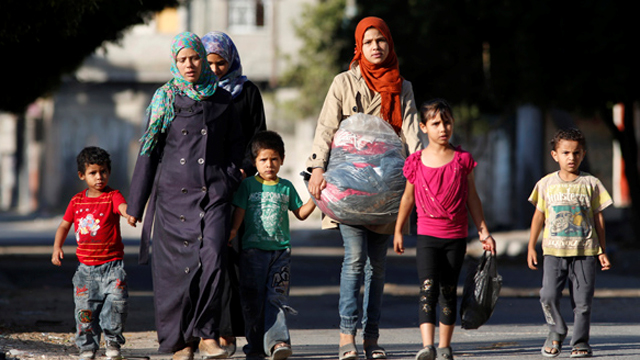
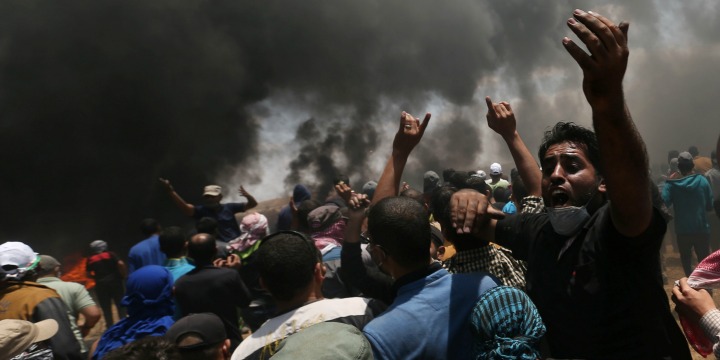
Today, Gaza is being bombarded.
Almost a thousand children have died. 50% of Palestinians are kids. The vehemently anti-Israel response from some parts of the left reflects a significant ideological evolution on the issue, especially among younger generations.
According to Spain’s Minister of Social Rights, given the attempted genocide carried out by the State of Israel, Netanyahu should be taken to an international criminal court for war crimes. And this opinion is now shared by many countries.
The foremost concern of western governments as the Israel-Hamas war enters a murderous second week is not the plight of Palestinians in Gaza. It is the alarming prospect of a swiftly spreading conflict pitting Israeli and US forces against Iran and its militia proxies. But Israel will not be stopped. A high-risk, full-scale ground offensive into northern Gaza is imminent, and most western leaders surely wish it wasn’t happening.
Israel is now pulverizing the Gaza territory
The Israeli government’s mass evacuation order from northern Gaza is an ostensibly humanitarian act done in an utterly inhumane way. The order requires 1.1 million people to flee their homes in northern Gaza in advance of an imminent Israeli ground invasion, the next step in the Israeli response to the horrendous Hamas massacre and abduction of Israeli civilians on 7 October.
Warring parties, if possible, are supposed to give “effective advance warning of attacks”. Yet the Israeli order will compound the suffering of the Palestinian civilians of Gaza. It may also begin an illegal process of ethnic cleansing.
The threat in northern Gaza is plenty real as Israeli bombers pulverize neighborhoods in attacks that appear designed less to pinpoint Hamas fighters than to collectively punish the civilian population of Gaza, the same population that has endured years of Hamas’s military dictatorship and had no say in Hamas’s decision to slaughter Israeli civilians.
There is nothing utopian about insisting that the Israeli military abide by the requirements of international humanitarian law. These requirements are not a concoction of human rights groups. They are rules agreed to by all governments including Israel’s.
For the sake of Palestinian civilians, the Western governments that are embracing Israel’s unquestionable right to respond to Hamas’s vicious assault should also insist that Israel abide by the same rules that make Hamas’s targeting of civilians an unlawful way to fight against Israel’s occupation.
Nothing can justify the horrific attacks Israel suffered last week. But those attacks cannot justify an unlimited destruction of Gaza and its people. The imposition of sieges that endanger the lives of civilians by depriving them of electricity, food and water is prohibited under international humanitarian law, as are indiscriminate military attacks and forced deportation of people.
Gaza is a small, closed, and besieged area that is being bombarded, with nowhere safe to go. All parties must immediately cease violations of international law, respect human dignity, provide civilians safe passage, and allow humanitarian agencies to reach those trapped in this conflict.
The international community must shoulder its responsibility to address the root causes of the current escalation, including five decades of occupation and annexation pursued by Israel, and identify viable paths to prevent further violations of international law, human suffering, and bloodshed.
Terrorism is never and never will be an answer to terrorism.
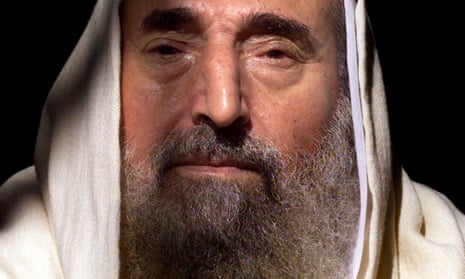
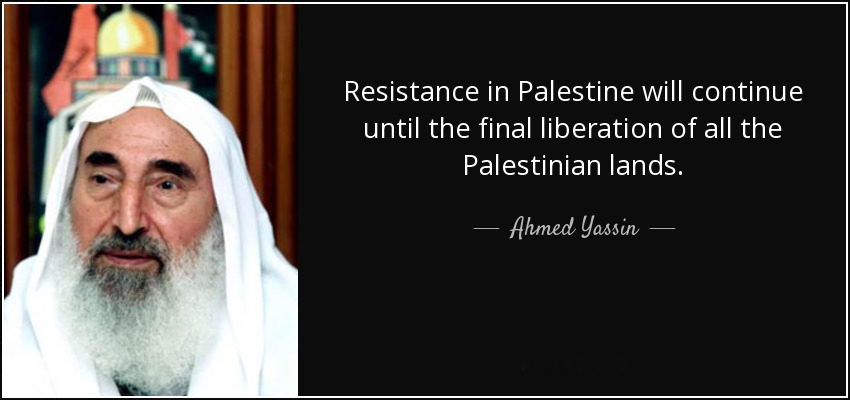
Sheikh Yassin, the Hamas Founder and Spiritual Leader
Assassinated March 22, 2004, by the Israeli forces while he was being wheeled out of an early morning prayer session in Gaza city, Yassin, 67, was the founder and spiritual leader of Hamas.
Born near the city of Ashkelon, now part of Israel, and moved to Gaza as a refugee after the state of Israel was created in 1948. Paralyzed in a childhood accident, he lived his life confined to a wheelchair.
As a student in Egypt, he joined the Muslim Brotherhood, a social and political movement that was outlawed by Egypt in 1954. He was arrested by Egyptian authorities in 1965. After returning to Gaza, Yassin had by 1968 become a leader of the Muslim Brotherhood. In the 1980s, his group was supported by Israel as an alternative to Yasir Arafat’s Palestinian Liberation Organization (PLO). Yassin established Hamas at the beginning of the first intifada in 1987.
He was arrested by Israel in 1989 and sentenced to life imprisonment for ordering attacks on Israeli soldiers. But he was released in 1997 by then-prime minister Benjamin Netanyahu in exchange for two agents from Mossad, Israel’s intelligence organization, who were captured in Jordan after a failed attempt to assassinate other Hamas leaders. Israel has tried to kill Yassin before; in September 2003 it dropped a bomb on a building where he was meeting with other Palestinian leaders. Yassin escaped that attack with light injuries.
An unlikely leader
Ahmed Yassin was an unlikely leader. Twisted awkwardly in a rusting wheelchair, his tiny body racked by a fit of coughing, in a 1988 interview, he explained quietly why, in the name of Islam, the Palestinians must maintain their armed struggle against Israel.
Despite his frail appearance, Sheikh Yassin spoke with an authority based on unshakeable faith. “If we want a Palestinian state we must have Palestinian land,” he insisted. “There is no point in making a state on paper. Our state will be Islamic.”
Nine months into the uprising in the Israeli-occupied West Bank and Gaza Strip, the crippled sheikh, and others like him represent a powerful opposition to those who seek to translate the sacrifices of the intifada into concrete political gains.As the PLO abroad agonised over whether to declare Palestinian independence unilaterally, form a government-in-exile, or amend the movement’s covenant, Muslim radicals in the occupied territories were making it clear that they opposed any concessions.
Sheikh Yassin was the spiritual leader of the Islamic Resistance Movement, which was born and bred in the squalor and misery of Gaza and encouraged, or at least ignored, by the Israelis, until they realised belatedly it would not supplant the PLO.
The movement, known by its Arabic acronym as Hamas, has been active since the intifada erupted. Occasionally it has challenged the mainstream, PLO-backed United National Leadership of the Uprising and called for its own strike days and protests.
However, as the PLO faced up to the challenge of matching months of sustained unrest with politically imaginative ideas, Hamas has become firmer in its views, raising the old spectre of divisions within the Palestinian ranks at a time when the need for unity has become a byword.
Leaflet number 25 issued by the United Leadership condemned Hamas for “serving the enemy”. Independent strike calls were described as “an imposition of authority on the street by force”.
Hamas’ ideas are influenced by the Muslim Brotherhood organisations in Jordan and Egypt. Its activists in the occupied territories have been blamed in the past for attacking left-wing, PLO-backed institutions.
Secularism, democracy, and other planks of PLO ideology were utterly alien. Its manifesto stated: “There is no solution to the Palestine problem except through Jihad.”
The Hamas manifesto approvingly quoted the notorious antisemitic forgery, the Protocols of the Elders of Zion, and warns of Israeli plans to conquer Arab and Muslim lands “from the Nile to the Euphrates”.
Sheikh Yassin was slightly more guarded, but there was no mistaking for his vision of the future: “It is not enough to have a state in the West Bank and Gaza,” he argued. “The best solution is to let all, Christians, Jews and Muslims, live in Palestine, in an Islamic state.”
Allah, he believes, was on his movement’s side. “When oppression increases,” the sheikh explained in his elegant, classical Arabic, “people start looking for God.”
The massacre of more than 1,200 Israeli citizens, most of them civilians, has focused global attention on the question of what Hamas is and what it represents.
An acronym for the Islamic Resistance Movement, Hamas was founded as an offshoot of the Muslim Brotherhood in 1987 on three pillars: religion, charity, and the fight against Israel. Under one of its key founders, the group’s spiritual leader, Sheikh Ahmed Yassin, it held an uncompromising view.
As the movement’s founding charter made clear, Hamas was dedicated from the start to extinguishing the existence of the state of Israel. It saw armed violence as part of that struggle, modelling its early armed wing on the fedayeen, Palestinian armed groups that emerged in the 1950s after the establishment of the state of Israel.
That armed wing would come to be known as the “Izz ad-Din al Qassam” brigades who, in conjunction with Islamic Jihad, from their very beginning embraced the use of terror tactics against Israel, carrying out their first suicide bombing in 1993, the movement attracting substantial popular support from teachers, surgeons, urban planners, and police in its civil administration of Gaza.
Hamas is unavoidably part of the fabric of the life in Gaza. While it runs Gaza’s health service, it is also a sinister organization committed to the mass murder of Israelis. It administers the education service while its police have broken the bones of children caught wearing scarfs signalling family affiliation with the rival Fatah movement. It also runs the courts. During the 2014 Gaza war, its forces abducted, tortured, and murdered Palestinians accused of “collaborating” with Israel and others.
For most people Hamas is represented by its armed wing, responsible for the brutal massacre at the October 7, 2023 weekend.
Along with Palestinian Islamic Jihad, after the 1993 Oslo peace accords, Hamas deployed suicide bombings as its initial weapon of choice against the peace deal, a tactic that would be seen regularly during the second intifada. Meanwhile, the Qassam brigades grew stronger, particularly in Gaza, becoming the substantial, well-armed and well-trained paramilitary force of today.
While the exact numbers are unclear and disputed, the Qassam brigades are today believed to count on several tens of thousands under arms including small boat forces, combat divers, a new para-glider force and drone operators.
The turning point for Hamas came in 2007.
After a period of deadly anarchy in Gaza, because of the 2006 Palestinian elections, Hamas-backed candidates won the largest share of the vote and seized power in the coastal Gaza enclave.
In power, Hamas, proved to be brutal and often greedy. Senior figures were implicated in damaging pyramid schemes linked to the once-flourishing smuggling tunnels to Egypt. Big villas appeared in its southern strongholds. Analysts would speak of a “black budget” which funneled money to the military wing and powerful individuals.
In this period, the messaging from senior figures in the political bureau was contradictory. As Yassin and his fellow founder Abdel Aziz al-Rantissi had done before their assassinations by Israel in 2004, Hamas leaders would suggest the possibility of a long cessation of hostilities with Israel, known as a “hudna.” That would suggest they could be pragmatic. Whether it was real or not, the threat of violence against Israel, and Jews more widely, was never far from the surface.
What would forge Hamas into its current shape was the blockade imposed by Israel in 2007 and the subsequent Gaza wars that would repeat themselves in a vicious cycle. Largely shut off from the world, the Qassam brigades grew both in size and importance. Violence became self-fulfilling. War with Israel legitimized Hamas’s role in Palestinian society and the wider Middle East.
After the 2008 Gaza conflict, support for Hamas rose sharply worldwide. This year a Hamas delegation visited Moscow and Saudi Arabia as it sought a wider international hearing.
Today, the most hard-line of the Hamas’ hardliners appear to be in the driving seat of the organization, representing the growing influence of the military wing’s shadowy head Mohammed Deif and the apparent decision by Yahya Sinwar, the current head of Hamas in Gaza, to align himself with a policy of all-out war.
Zelensky: a professional comedian who has shrewdly seized the moment to radically rebrand himself as a symbol of resistance, freedom, and democracy, a sort of cross between Che Guevara and Rambo.
While the Ukraine-Russia conflict is an unnecessary tragedy, it is time for military and financial aid to Ukraine to end.
While the Ukraine-Russia conflict is an unnecessary tragedy, this ongoing battle does not much threaten America and it is now time for our politicians and government to focus money and energy on problems closer to home. They should stop spending billion dollars over there in Ukraine and start spending a lot more money at home and take care of our own people.
The Ukraine-Russia conflict should not be our and our governments top concern. This should have stopped long ago. Money and weapons shipments from western states to the Zelensky regime are only helping to escalate the conflict, with devastating global implications.
The veneration and even mythification of Zelensky, which has reached absurdist levels, is partly explained by an understandable detestation of the aggressor, Russian President Vladimir Putin, and by the acting talents of Zelensky, a professional comedian who has shrewdly seized the moment to radically rebrand himself as a symbol of resistance, freedom, and democracy, a sort of cross between Che Guevara and Rambo.
Ukraine’s army has not made any significant breakthrough. Ever more strident demands for ever more aid, doled out and regardless of circumstances, make this conflict potentially endless and fruitless.
Only a negotiated settlement, no matter how unsatisfying, offers a possible resolution of the conflict.
“The killer is still on the run…” “Russia-Ukraine war …” “Environment and Climate crisis…” “Inflation….” “Housing….” “Costs of living…” “AI….” “The crisis is worsening…” “The number of casualties is rising…” “Mass shooting in …” “Politicians empty promises…” “Trump again …” “Transgenders…” “LGBTQ….”
…
These are words we hear and read about, repeatedly, on a regular basis, not to say a daily basis.
Like many others, I used to consume a lot of news every day. Reading the news somehow made me feel good. I felt like I knew what was going on in the world and that I was up to date on important developments.
Over time, I started questioning myself about why I was constantly reading this negative news, even when, most of the time, they did not necessarily provide new information.
Recently, thanks to Donald Trump, Justin Trudeau, Greta Thunberg, Volodymyr Zelenskyy, I completely lost the appetite for news or, more precisely, immersing myself in the 24-hour news cycle. I realized that whatever I was reading or hearing on any given day was a repeat of what was already news a few years ago and will still be relevant in a few years from now.
After thinking about this some more, I also realize that unbiased news does not exist, that there is a proliferation of fake news circulating around and that being up to date on the news does not necessarily make me informed about the world. So, from one day to the next I quit the 24-hour news cycle, cold-turkey.
And this happened.
I felt an unprecedented sense of peace and contentment. changing my media habits took my general mood to the next level. On a fundamental level, I found myself just being very much at peace. I also noticed an increased curiosity about several different things and became much more more informed. For instance, I started brushing up my knowledge about the history of Ancient Egypt. Reading more about events of historical significance helped me put the present into perspective.
I also realized that even without reading or following the news anymore, I was still up to date. If there were important news, someone would inevitably let me know, often right away. People I know would mention it verbally or in an email, share an article with me over social media or email. I would also check the front page of news outlets and scan the headlines of the articles. This helped me ensure that I was not missing any important developments without getting caught back in the 24-hour news cycle.











 J. Michael Dennis ll.l., ll.m. Live
You must be logged in to post a comment.