
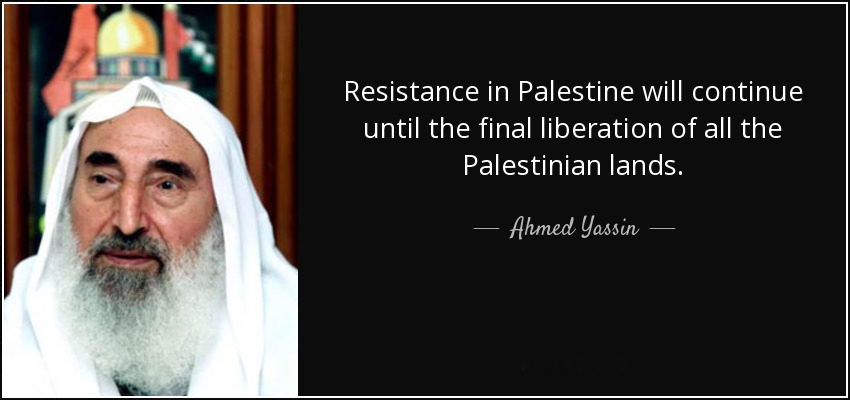
Hamas founder Sheikh Yassin
The massacre of more than 1,200 Israeli citizens, most of them civilians, has focused global attention on the question of what Hamas is and what it represents.
An acronym for the Islamic Resistance Movement, Hamas was founded as an offshoot of the Muslim Brotherhood in 1987 on three pillars: religion, charity, and the fight against Israel. Under one of its key founders, the group’s spiritual leader, Sheikh Ahmed Yassin, it held an uncompromising view.
As the movement’s founding charter made clear, Hamas was dedicated from the start to extinguishing the existence of the state of Israel. It saw armed violence as part of that struggle, modelling its early armed wing on the fedayeen, Palestinian armed groups that emerged in the 1950s after the establishment of the state of Israel.
That armed wing would come to be known as the “Izz ad-Din al Qassam” brigades who, in conjunction with Islamic Jihad, from their very beginning embraced the use of terror tactics against Israel, carrying out their first suicide bombing in 1993, the movement attracting substantial popular support from teachers, surgeons, urban planners, and police in its civil administration of Gaza.
Hamas is unavoidably part of the fabric of the life in Gaza. While it runs Gaza’s health service, it is also a sinister organization committed to the mass murder of Israelis. It administers the education service while its police have broken the bones of children caught wearing scarfs signalling family affiliation with the rival Fatah movement. It also runs the courts. During the 2014 Gaza war, its forces abducted, tortured, and murdered Palestinians accused of “collaborating” with Israel and others.
For most people Hamas is represented by its armed wing, responsible for the brutal massacre at the October 7, 2023 weekend.
Along with Palestinian Islamic Jihad, after the 1993 Oslo peace accords, Hamas deployed suicide bombings as its initial weapon of choice against the peace deal, a tactic that would be seen regularly during the second intifada. Meanwhile, the Qassam brigades grew stronger, particularly in Gaza, becoming the substantial, well-armed and well-trained paramilitary force of today.
While the exact numbers are unclear and disputed, the Qassam brigades are today believed to count on several tens of thousands under arms including small boat forces, combat divers, a new para-glider force and drone operators.
The turning point for Hamas came in 2007.
After a period of deadly anarchy in Gaza, because of the 2006 Palestinian elections, Hamas-backed candidates won the largest share of the vote and seized power in the coastal Gaza enclave.
In power, Hamas, proved to be brutal and often greedy. Senior figures were implicated in damaging pyramid schemes linked to the once-flourishing smuggling tunnels to Egypt. Big villas appeared in its southern strongholds. Analysts would speak of a “black budget” which funneled money to the military wing and powerful individuals.
In this period, the messaging from senior figures in the political bureau was contradictory. As Yassin and his fellow founder Abdel Aziz al-Rantissi had done before their assassinations by Israel in 2004, Hamas leaders would suggest the possibility of a long cessation of hostilities with Israel, known as a “hudna.” That would suggest they could be pragmatic. Whether it was real or not, the threat of violence against Israel, and Jews more widely, was never far from the surface.
What would forge Hamas into its current shape was the blockade imposed by Israel in 2007 and the subsequent Gaza wars that would repeat themselves in a vicious cycle. Largely shut off from the world, the Qassam brigades grew both in size and importance. Violence became self-fulfilling. War with Israel legitimized Hamas’s role in Palestinian society and the wider Middle East.
After the 2008 Gaza conflict, support for Hamas rose sharply worldwide. This year a Hamas delegation visited Moscow and Saudi Arabia as it sought a wider international hearing.
Today, the most hard-line of the Hamas’ hardliners appear to be in the driving seat of the organization, representing the growing influence of the military wing’s shadowy head Mohammed Deif and the apparent decision by Yahya Sinwar, the current head of Hamas in Gaza, to align himself with a policy of all-out war.

J. Michael Dennis, ll.l., ll.m.
FREE SPEECH ABSOLUTIST / PERSONAL & CORPORATE FIXER
Systemic Strategic Planning; Regulatory Compliance; Crisis & Reputation Management
 J. Michael Dennis ll.l., ll.m. Live
You must be logged in to post a comment.