
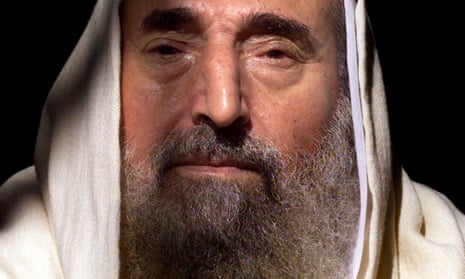
Sheikh Yassin, the Hamas Founder and Spiritual Leader
Assassinated March 22, 2004, by the Israeli forces while he was being wheeled out of an early morning prayer session in Gaza city, Yassin, 67, was the founder and spiritual leader of Hamas.
Born near the city of Ashkelon, now part of Israel, and moved to Gaza as a refugee after the state of Israel was created in 1948. Paralyzed in a childhood accident, he lived his life confined to a wheelchair.
As a student in Egypt, he joined the Muslim Brotherhood, a social and political movement that was outlawed by Egypt in 1954. He was arrested by Egyptian authorities in 1965. After returning to Gaza, Yassin had by 1968 become a leader of the Muslim Brotherhood. In the 1980s, his group was supported by Israel as an alternative to Yasir Arafat’s Palestinian Liberation Organization (PLO). Yassin established Hamas at the beginning of the first intifada in 1987.
He was arrested by Israel in 1989 and sentenced to life imprisonment for ordering attacks on Israeli soldiers. But he was released in 1997 by then-prime minister Benjamin Netanyahu in exchange for two agents from Mossad, Israel’s intelligence organization, who were captured in Jordan after a failed attempt to assassinate other Hamas leaders. Israel has tried to kill Yassin before; in September 2003 it dropped a bomb on a building where he was meeting with other Palestinian leaders. Yassin escaped that attack with light injuries.
An unlikely leader
Ahmed Yassin was an unlikely leader. Twisted awkwardly in a rusting wheelchair, his tiny body racked by a fit of coughing, in a 1988 interview, he explained quietly why, in the name of Islam, the Palestinians must maintain their armed struggle against Israel.
Despite his frail appearance, Sheikh Yassin spoke with an authority based on unshakeable faith. “If we want a Palestinian state we must have Palestinian land,” he insisted. “There is no point in making a state on paper. Our state will be Islamic.”
Nine months into the uprising in the Israeli-occupied West Bank and Gaza Strip, the crippled sheikh, and others like him represent a powerful opposition to those who seek to translate the sacrifices of the intifada into concrete political gains.As the PLO abroad agonised over whether to declare Palestinian independence unilaterally, form a government-in-exile, or amend the movement’s covenant, Muslim radicals in the occupied territories were making it clear that they opposed any concessions.
Sheikh Yassin was the spiritual leader of the Islamic Resistance Movement, which was born and bred in the squalor and misery of Gaza and encouraged, or at least ignored, by the Israelis, until they realised belatedly it would not supplant the PLO.
The movement, known by its Arabic acronym as Hamas, has been active since the intifada erupted. Occasionally it has challenged the mainstream, PLO-backed United National Leadership of the Uprising and called for its own strike days and protests.
However, as the PLO faced up to the challenge of matching months of sustained unrest with politically imaginative ideas, Hamas has become firmer in its views, raising the old spectre of divisions within the Palestinian ranks at a time when the need for unity has become a byword.
Leaflet number 25 issued by the United Leadership condemned Hamas for “serving the enemy”. Independent strike calls were described as “an imposition of authority on the street by force”.
Hamas’ ideas are influenced by the Muslim Brotherhood organisations in Jordan and Egypt. Its activists in the occupied territories have been blamed in the past for attacking left-wing, PLO-backed institutions.
Secularism, democracy, and other planks of PLO ideology were utterly alien. Its manifesto stated: “There is no solution to the Palestine problem except through Jihad.”
The Hamas manifesto approvingly quoted the notorious antisemitic forgery, the Protocols of the Elders of Zion, and warns of Israeli plans to conquer Arab and Muslim lands “from the Nile to the Euphrates”.
Sheikh Yassin was slightly more guarded, but there was no mistaking for his vision of the future: “It is not enough to have a state in the West Bank and Gaza,” he argued. “The best solution is to let all, Christians, Jews and Muslims, live in Palestine, in an Islamic state.”
Allah, he believes, was on his movement’s side. “When oppression increases,” the sheikh explained in his elegant, classical Arabic, “people start looking for God.”

J. Michael Dennis, ll.l., ll.m.
FREE SPEECH ABSOLUTIST / PERSONAL & CORPORATE FIXER
Systemic Strategic Planning; Regulatory Compliance; Crisis & Reputation Management
 J. Michael Dennis ll.l., ll.m. Live
You must be logged in to post a comment.