• HOME PAGE
  • ABOUT JMD
  • CONTACT JMD
  • ONLINE VIRTUAL SERVICES
  • Publications

J. Michael Dennis ll.l., ll.m. Live

~ ~ JMD Live Online Business Consulting ~ a division of King Global Earth and Environmental Sciences Corporation

J. Michael Dennis ll.l., ll.m.  Live

Author Archives: JMD Live Online Business Consulting

Au Brésil, une manifestation monstre contre l’augmentation du coût de la vie

18 Tuesday Jun 2013

Posted by JMD Live Online Business Consulting in General

≈ Leave a comment

Tags

BRASILIA, Brazil, Coût de la vie, Manifestations populaires, São Paulo

Brazil 130617-protest-hmed-10p.photoblog600

BRASILIA – Des milliers de jeunes se massent aux portes du Parlement après des heures de manifestation.

Au moment où le Brésil connaît un ralentissement économique, des dizaines de milliers de Brésiliens descendent dans la rue pour protester contre l’augmentation du coût de la vie et la facture astronomique de la prochaine Coupe du Monde. La principale manifestation s’est tenue lundi à Rio de Janeiro où 100 000 personnes se sont rassemblées, alors que 65 000 se rassemblaient à Sao Paulo, la capitale économique du pays.

JMD

 jmdlive@lefuturistedailynews.com


Pour en savoir plus:

http://bigbrowser.blog.lemonde.fr/2013/06/18/changebrazil-suivre-les-manifestations-au-bresil-en-ligne/

Share this:

  • Share on X (Opens in new window) X
  • Share on Facebook (Opens in new window) Facebook
Like Loading...

Open with a punch, close with a kick

17 Monday Jun 2013

Posted by JMD Live Online Business Consulting in General

≈ Leave a comment

Tags

Copywriting, kicker, lede

Good+Writing+is+Hard+Work

Good writing

There are two words that every writer needs to know: “lede” and “kicker”.

A “lede” is the opening sentence of an article. A “kicker” is the last. If you can get them right, you can lift what you write to a whole new level.

JMD

Share this:

  • Share on X (Opens in new window) X
  • Share on Facebook (Opens in new window) Facebook
Like Loading...

Multitasking or the art of looking stupid

15 Saturday Jun 2013

Posted by JMD Live Online Business Consulting in General

≈ 1 Comment

Tags

Chaos, Health, Multitasking, Neurological Disorders, Stupidity

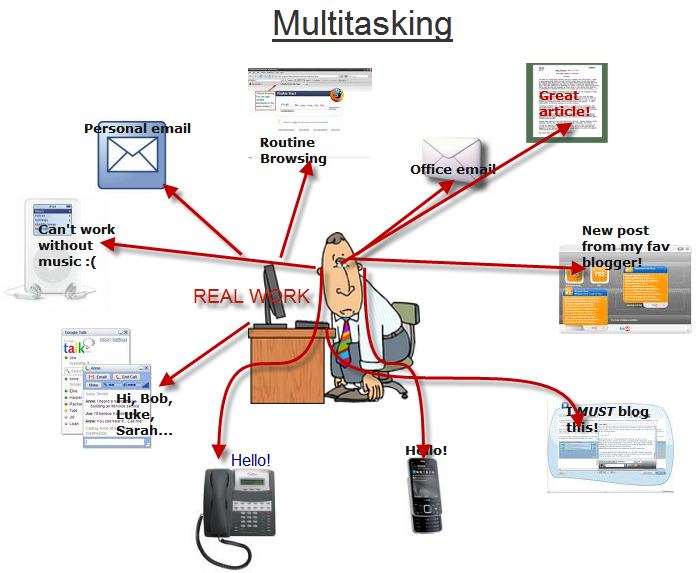
multitasking

Here’s the catch:

Multitasking messes with the brain in several ways.

At the most basic level, the mental balancing acts that it requires energize regions of the brain that specialize in visual processing and physical coordination and simultaneously appear to shortchange some of the higher areas related to memory and learning. We concentrate on the act of concentration at the expense of whatever it is that we are supposed to be concentrating on.

Another negative effect of multitasking is that such a practice boosts your level of stress-related hormones such as cortisol and adrenaline and wears down your immune and physiological systems through biochemical friction. In the short run, confusion, fatigue, and chaos merely hamper our ability to focus and analyze, but in the long term, such a repeated practice of multitasking will result in atrophy of the brain and cause premature aging.

On a more mundane note, multitasking is the reason why you get less done in a day than you would like or like to think you do. You go from one task to the other, without completing one; you go from answering emails to phone calls, to tinkering with your computers and nothing is getting done. You are merely procrastinating and complaining that the days are too short or not getting paid enough for all what you have to do.

What was I saying about multitasking creating chaos!

JMD

Share this:

  • Share on X (Opens in new window) X
  • Share on Facebook (Opens in new window) Facebook
Like Loading...

Are You Boring?

14 Friday Jun 2013

Posted by JMD Live Online Business Consulting in General

≈ 1 Comment

Tags

Audience, Boredom, Keynotes, Posture, Speaking

Bored-Lady

Please, shut up and go away!

Like many of you, I have often experienced doubts and questioned myself on the pertinence and the effectiveness of my techniques and discourses when addressing people.

With time, I came up with a list of indicators that are definitely indicating or pointing in the right direction when it is time to find out if I might be boring or interesting someone:

Repeated, perfunctory responses: A person who says, “Oh really? Oh really? That is interesting. Oh really?” is probably not very engaged and hoping for you to go away as fast as possible. The same for the person who keeps saying: “That is hilarious.” 

Simple questions: People who are bored ask simple questions such as: “When did you come to town?” “Where do you come from?” People who are interested ask more complex questions that show curiosity, not mere politeness.

Interruptions: Interruptions are actually a good sign. It means a person is bursting to say something, and that shows interest.

Request for clarification: A person who is sincerely interested will need you to elaborate or explain. “What does that term mean?” “When exactly did that happen?”

Imbalance of talking time: Too often during a conversation, many will fondly suppose that if they do eighty percent of the talking, it is because people find them fascinating. This is rarely true. In general, people will want to have their saying, to add their own opinions, information, and experiences to a discussion. If they are not doing that, they may just want the conversation to end faster.

Body position: People with a good connection generally turn fully to face each other. A person who is partially turned away is not fully embracing the conversation. Pay special attention to body position when you are addressing someone. If the person is not sitting forward, looking down at papers, gazing into space, or checking his or her phone instead of keeping their attention obviously focused on you, this person is not interested whatsoever in what you say. 

Along the same lines, if you are a speaker trying to figure out if an audience is interested in what you are saying, just remember that people tend to slouch and lean when bored. You can measure the boredom of an audience by seeing how far from vertically upright they are. Also remember that attentive people fidget less than bored people. An audience that is upright and still is interested, while an audience that is horizontal and squirmy is bored.

JMD

Share this:

  • Share on X (Opens in new window) X
  • Share on Facebook (Opens in new window) Facebook
Like Loading...

Stealing from the poor

08 Saturday Jun 2013

Posted by JMD Live Online Business Consulting in General

≈ Leave a comment

Tags

Consumerism, Food, Oppression, Pope, Poverty

world food large

Wasting food is like stealing from the poor, says pope

ROME – Pope Francis denounces what he calls a “culture of waste” in an increasingly consumerist world: “Throwing away food is like stealing from the table of those who are poor and hungry.” 

Around 1.43 billion tons of food, or one third of what is produced for human consumption, gets lost or wasted every year. In the industrialized world the majority of waste is by consumers, often because they buy too much and have to throw away what they do not manage to eat. Better storage and reducing over-sized portions would sharply reduce the vast amount of food going to waste. 

Francis said the “culture of waste” is especially deplorable given the prevalence of hunger in the world. Hunger affects some 870 million people, while 2 billion suffer from at least one nutritional deficiency. 

The pontiff warned that too much focus on money and materialism meant financial market dips were viewed as tragedies while human suffering had become normal and ignored. “In this way people are discarded as if they were garbage,” he says.

Who can argue with that?

JMD

 jmdlive@lefuturistedailynews.com

Read More:

http://worldnews.nbcnews.com/_news/2013/06/05/18780415-wasting-food-is-like-stealing-from-the-poor-says-pope?lite

http://www.ntnews.com.au/article/2010/10/27/189731_ntnews.html


Share this:

  • Share on X (Opens in new window) X
  • Share on Facebook (Opens in new window) Facebook
Like Loading...

Our survival may well be in jeopardy

03 Monday Jun 2013

Posted by JMD Live Online Business Consulting in General

≈ Leave a comment

Tags

2004 Indian Ocean earthquake and tsunami, Climate change, Hurricane Sandy, Kobe, Natural disaster, United Nations

chaiten-volcano

Mankind is now engaging in the biggest battle ever seen

ALJAZEERA – Climate change and poor planning are worsening the toll in lives and money that natural disasters wreak worldwide.

We are in a really delicate situation now where even our survival may be in jeopardy. The list of problems facing our planet is growing everyday. Natural disasters are increasing around the world claiming lives and costing billions of dollars in damage. The UN has estimated the direct economic cost of disasters since 2000 is roughly $1.4tn, cautioning that the total price tag on people’s livelihoods and the wider economy are never fully counted.

Japan’s earthquake and tsunami of 2011 was probably the most costly natural disaster in history, causing losses of hundreds of billions of dollars. Last October’s Superstorm Sandy cost the United States more than $50bn, while also devastating Cuba, Haiti, and other Caribbean nations. Record wildfires last year in Russia and the US burned through millions of acres, following another unprecedented Russian summer in 2010 when heat waves claimed 55,000 lives.

The UN Intergovernmental Panel on Climate Change (IPCC) reported last year that droughts and heat waves are growing harsher and longer in many regions, causing deaths, fires and crop failure. When rain does come, it is often more intense, causing flooding and landslides. Meanwhile, rising sea levels increase the height and damage potential of storm surges in coastal areas.

In 2005, the Hyogo Framework for Action was adopted to encourage countries to become more resilient in the face of natural disasters. But the Global Assessment Report reveals that efforts have had limited success so far. 121 countries have passed legislation for reducing disaster risks since 2005, and more than half of the governments have made substantial progress in assessing and monitoring the risks their people face. But this has had no discernible affect on disaster losses, which continue to stack up around the world.

So far, each step towards a global framework for addressing disasters has been framed by massive natural events. The Hyogo Framework was established in Kobe, Japan, as bodies were still being recovered from the Indian Ocean tsunami of 2004. The recent disasters casting shadows on this year’s event brought greater attention to the likelihood that climate change is worsening the intensity of weather events. Other than climate change, reckless urban development, the exploitation of groundwater, and deforestation are increasing the likelihood of disasters large and small, and weaken the resilience of communities to withstand them. The Global Assessment Report highlighted that many people suffering the worst effects of climate disasters are not the ones contributing to them.

And this is only the beginning.

JMD

 jmdlive@lefuturistedailynews.com

Read More:

http://www.aljazeera.com/indepth/features/2013/05/20135278951818557.html


Share this:

  • Share on X (Opens in new window) X
  • Share on Facebook (Opens in new window) Facebook
Like Loading...

World’s cost of living 2013

30 Thursday May 2013

Posted by JMD Live Online Business Consulting in General

≈ Leave a comment

Tags

Costs of living, Japan, Los Angeles, Melbourne, New York City, Sydney, Tokyo, Vancouver, Zurich

tokyo-japan

Tokyo, the most expensive city of the world

TOKYO – After currency swings pushed Zurich to the top of the ranking last year, Tokyo has resumed its place as the world’s most expensive city.

Despite Japanese deflation, a weaker yen and rising prices throughout the world, Tokyo has resumed its position as the world’s most expensive city. Tokyo took over Zurich, which dropped to seventh. A strong local currency powered Sydney in third place and Melbourne in equal fourth place while Singapore rose to sixth.

Asian cities now make up 11 of the world’s 20 most expensive cities in the world. Caracas now makes it in ninth place, making it the most expensive city across the Americas while Vancouver is still he most expensive location in North America at position 21. Los Angeles and New York City tie at 27th as the most expensive U.S. cities.

South Asian locations dominated the cheapest cities to live in.

JMD

 jmdlive@lefuturistedailynews.com

Read More:

https://www.eiu.com/public/topical_report.aspx?campaignid=Wcol2013

Share this:

  • Share on X (Opens in new window) X
  • Share on Facebook (Opens in new window) Facebook
Like Loading...

The Minimum Wage: Does It Matter?

29 Wednesday May 2013

Posted by JMD Live Online Business Consulting in General

≈ 1 Comment

Tags

Costs of living, Inflation, Minimum wage, Poverty

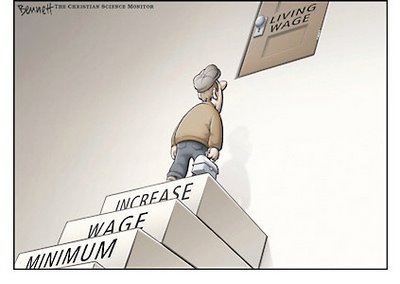
Minimum-Wage

Increase in minimum wage

WORLD – Since minimum wages are not indexed to inflation, they do not systematically increase in proportion to changes in the costs of living. 

Those in favor of increasing the minimum wage will argue that such an increase would lift people out of poverty, helps low-income families make ends meet and narrows the gap between the rich and poor. But forget about all of this. That last argument is underscored by the exorbitant salaries earned by CEOs and other corporate titans, which are also the same people generally arguing against an increase in the minimum wage.

Instead of cutting down on their salaries, which, by the way, is paid by the business and the income that you generate being paid generating revenue at minimum wage to pay their extravagant salaries that they earn sitting ion their office or at the private club, their argument is that allowing you to have a decent wage thus, a decent life, would hurt small businesses, squeeze profit margins, lead to inflation, encourages employers to downsize their staff and increases the cost of goods to the end consumer. What a bunch of baloney I say!

For some others, economically speaking, the theory of supply and demand suggests that the imposition of an artificial value on wages that is higher than the value that would be dictated in a free-market system creates an inefficient market and leads to unemployment. According to this theory, the inefficiency occurs when there are a greater number of workers that want the higher paying jobs than there are employers willing to pay the higher wages. What a bunch of baloney I say!

Keep in mind that earning more than minimum wage does not necessary mean that one is not living in poverty. According to estimates, some 37 millions people lives in poverty in the United States only. What about Canada? What about Spain? Greece? France… What about the world? Unless we all collectively take charge of our life and destiny now and decide to empower ourselves, nothing is going to happen. No matter how high is the minimum wage, too many will still be unemployed or living in poverty.

And this, my friends, is no baloney!

JMD

 jmdlive@lefuturistedailynews.com

Share this:

  • Share on X (Opens in new window) X
  • Share on Facebook (Opens in new window) Facebook
Like Loading...

One quarter of world’s children struggling to learn because of malnutrition

28 Tuesday May 2013

Posted by JMD Live Online Business Consulting in General

≈ Leave a comment

Tags

Economic growth, Ethiopia, India, Malnutrition, Peru, Save the Children, Vietnam

hungry_kids

Three hungry kids – One in every four in the world!

The Food for Thought report by Save the Children – One in every four children in the world is suffering from chronic malnutrition that is affecting their ability to learn, according The Food for Thought report by Save the Children. The study also revealed that undernourished children were an average of 20 percent less literate than those who had a “nutritious diet.” It is said that that malnutrition could affect global economic growth by $125 billion.

“A quarter of the world’s children are suffering the effects of chronic malnutrition. Poor nutrition in the early years is driving a literacy and numeracy crisis in developing countries and is also a huge barrier to further progress in tackling child deaths. Improving the nutritional status of children and women in the crucial 1,000 day window, from the start of a woman’s pregnancy until her child’s second birthday, could greatly increase a children’s ability to learn and to earn,” says Carolyn Miles, president and chief executive of Save the Children.

The report found that malnourished children: scored 7 percent lower in math tests and were 19 percent less likely to be able to read at the age of 8; were 13 percent less likely to be in the appropriate school grade for their age; were likely to earn at least 20 percent as adults. It says that extrapolating a 20-percent reduction in earnings to a global level would mean childhood malnutrition could potentially cost the global economy some $125 billion in 2030.

The report was based on studies of thousands of children in Ethiopia, India, Peru and Vietnam and noted there had been “huge progress” in helping children over the last two decades. Between 1990 and 2011, the number of children who died before the age of 5 fell from 12 million to 6.9 million, faster than ever before. And since 1999, the number of kids in elementary school had gone up by more than 40 million. However, malnutrition threatens to undermine these impressive advances.

In spite of the reduction in children dying, the global crisis of child mortality remains unsolved, 19,000 children continue to die each day from preventable causes. Meanwhile, a global crisis in education means 130 million children are in school but failing to learn even the basics. They are left without the core skills and abilities they need to fulfill their potential and to lead fulfilling, productive lives. Child malnutrition is a key factor underlying both these crises. Malnutrition is an underlying cause of 2.3 million children’s deaths a year and, for millions more children, contributes to failures in cognitive and educational development. As a result, the life chances of millions of children around the world are devastated.

The potential cost to the global economy runs to billions of dollars.

JMD

 jmdlive@lefuturistedailynews.com

Read More:

http://worldnews.nbcnews.com/_news/2013/05/28/18550564-one-quarter-of-worlds-children-struggling-to-learn-because-of-malnutrition-study?lite


Share this:

  • Share on X (Opens in new window) X
  • Share on Facebook (Opens in new window) Facebook
Like Loading...

New U.N. “Low” Population Projection for 2050

25 Saturday May 2013

Posted by JMD Live Online Business Consulting in General

≈ Leave a comment

Tags

Developing country, Natural resources, Population growth, United Nations, World Population Groth

un-black

United Nations Population Division

UNITED NATIONS – In a report released a few weeks ago, the United Nations Population Division slightly increased the projection usually used to forecast the size of the human population, predicting a world with 9.2 billion people by mid-century, up from nearly 6.8 billion today.

According to the report, in its low population estimate, nearly 8 billion people are to be expected on Earth by 2050. The high projection, however, foresees some 10.5 billion people; the medium projection being 9.2 billion people, all the growth coming from developing countries, developed countries having now largely painted themselves into a corner. In the near future, however, families in wealthier countries may decide to prolong or reconsider having children due to the economic recession.

According to the United Nations Population Division, for the next forty years, the overall world’s population growth is inevitable. As a result, natural resources such as fossil fuels, timber, minerals, and water will likely be severely depleted in many regions. According to the United Nations World Water Development Report, feeding the world’s expanding population will increase water demand by 70 to 90 percent in 2050. Population growth will also compounds global challenges like climate change and biodiversity loss.

Wake up everyone, this is less than forty years from now.

It is now, time to act!

JMD

 jmdlive@lefuturistedailynews.com

Read More:

http://www.worldwatch.org/node/6038

Share this:

  • Share on X (Opens in new window) X
  • Share on Facebook (Opens in new window) Facebook
Like Loading...
← Older posts
Newer posts →

Subscribe

  • Entries (RSS)
  • Comments (RSS)

Archives

  • February 2026
  • April 2024
  • March 2024
  • February 2024
  • January 2024
  • December 2023
  • November 2023
  • October 2023
  • July 2023
  • June 2023
  • May 2023
  • July 2021
  • April 2021
  • March 2021
  • February 2021
  • January 2021
  • November 2020
  • September 2020
  • August 2020
  • July 2020
  • June 2020
  • May 2020
  • April 2020
  • March 2020
  • February 2020
  • January 2020
  • October 2019
  • September 2019
  • August 2019
  • July 2019
  • June 2019
  • May 2019
  • April 2019
  • December 2018
  • October 2018
  • September 2018
  • June 2018
  • May 2018
  • March 2018
  • February 2018
  • January 2018
  • December 2017
  • November 2017
  • October 2017
  • September 2017
  • August 2017
  • July 2017
  • June 2017
  • February 2017
  • January 2017
  • December 2016
  • September 2016
  • August 2016
  • July 2016
  • June 2016
  • May 2016
  • April 2016
  • March 2016
  • February 2016
  • December 2015
  • September 2015
  • August 2015
  • February 2015
  • December 2014
  • September 2014
  • June 2014
  • May 2014
  • April 2014
  • February 2014
  • January 2014
  • December 2013
  • October 2013
  • September 2013
  • June 2013
  • May 2013
  • April 2013
  • March 2013
  • February 2013
  • January 2013
  • December 2012
  • November 2012
  • October 2012
  • September 2012
  • August 2012
  • July 2012
  • June 2012
  • May 2012
  • March 2012
  • February 2012
  • January 2012

Categories

  • Artificial Intelligence
  • Crisis & Reputation Management
  • General
  • Online Consulting
  • Public Affairs and Communications
  • Systemic Strategic Planning
  • The Future of AI

Meta

  • Create account
  • Log in
Follow J. Michael Dennis ll.l., ll.m. Live on WordPress.com

Enter your email address to follow this blog and receive notifications of new posts by email.

Blog at WordPress.com.

  • Subscribe Subscribed
    • J. Michael Dennis ll.l., ll.m. Live
    • Join 40 other subscribers
    • Already have a WordPress.com account? Log in now.
    • J. Michael Dennis ll.l., ll.m. Live
    • Subscribe Subscribed
    • Sign up
    • Log in
    • Report this content
    • View site in Reader
    • Manage subscriptions
    • Collapse this bar
 

Loading Comments...
 

You must be logged in to post a comment.

    %d