
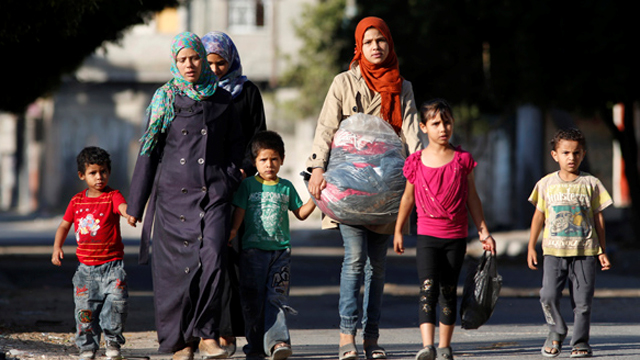
We owe it to humanity to see the rules of war are observed, no matter how tough a test the Israel-Hamas conflict proves. No set of crimes justifies another. To succumb to this principle would mean a never-ending cycle of violence.
For almost 4,000 years, most governments have insisted that if wars must be fought, there should be rules. The first known code, by the Babylonian king Hammurabi, laid down the principle on which all subsequent laws of war have been based: “To Prevent the Strong from Oppressing the Weak”.
During its assault, on Black Saturday, Hamas broke numerous laws of war, starting with its rocket fire into Israel, which made no attempt to discriminate between military and civilian targets, breaking article 13 of protocol II of the Geneva conventions. Its fighters allegedly murdered, tortured, and raped, breaking common article 3 of the Geneva conventions and articles 27 and 32 of the fourth convention. They also allegedly engaged in pillage and terrorism (33, fourth convention) and the taking of hostages (34, fourth, and article 8 of the Rome statute). Though this is harder to prove, these acts might have been motivated by genocidal intent, arguably also putting Hamas in breach of the genocide convention. Any of the people responsible who are captured should be tried for crimes against humanity.
In responding to this attack, Israel has also broken several laws of war. These crimes begin with the use of collective penalties against the people of Gaza (article 33 of the fourth convention and article 4 of protocol II). One aspect of this punishment appears to be the pattern of Israel’s bombing and shelling of Gaza.
“The emphasis is on damage and not on accuracy,” a spokesperson for the Israel Defense Forces announced, which looks to me like stated intent to commit a war crime. The war crime in this case is the damage to property: article 50 of the first Geneva convention, article 51 of the second Geneva convention and article 147 of the fourth Geneva convention. Many of the buildings hit, including numerous schools and health facilities, do not appear to qualify as military targets, despite Israeli claims that Hamas uses people as human shields. Such indiscriminate attacks contravene article 13, protocol II and article 53, fourth convention. The bombing of mosques breaks article 16 of protocol II.
Human Rights Watch claims that Israel has fired white phosphorus shells at Gaza and Lebanon during its counterattack, although this has been denied. White phosphorus munitions can legally be used on battlefields to make smokescreens, mark targets, or burn buildings, but it is considered an indiscriminate and terrible weapon, whose use in such cases might constitute a breach of the chemicals weapon convention.
The Israeli government has admitted cutting off essential supplies to Gaza. On 9 October, the defence minister, Yoav Gallant, stated: “I ordered a full siege on the Gaza Strip. No power, no food, no gas, everything is closed.” This is collective punishment. The energy minister, Israel Katz, appeared to confirm this when he wrote: “No electrical switch will be turned on, no water hydrant will be opened, and no fuel truck will enter until the Israeli abductees are returned home.” The siege also breaches articles 55, 56 and 59 of the fourth convention and article 14 of protocol II, which protects “objects indispensable to the survival of the civilian population”.
While the Israeli government could argue that instructing the people of Gaza City to leave is an attempt to protect them from bombardment, this directive constitute a breach of article 17 of protocol II, forbidding the forced movement of civilians, and of article 49 of the fourth convention on deportations and evacuations. Again, to judge by the statements of some officials, in the siege and attacks on Gaza there could be evidence of genocidal intent. The current fighting, of course, takes place in the context of Israel’s illegal occupation of Palestinian land, and the many subsidiary crimes associated with it.
No set of crimes justifies another
There are no excuses in war or ethics for crimes against humanity. There is never a legal reason to attack one person for the crimes of another, to confuse a people with their government or with the armed forces that claim to defend them, on either side of any conflict. The issue, as always, is enforcement, the most powerful countries customarily refusing to succumb to the rule of law. The laws of war, it seems, are for the little people.
So why bother? Why even mention war crimes, knowing that the charge is unlikely to be enforced against powerful perpetrators? Why not accept that war and atrocity are inextricable?
I will tell you why! Because it is upon these laws that aspects of our humanity hang. If we succumb to cynicism, if we are dissuaded by the hypocrisy of the dominant powers, if we cannot demand and hope for a better world, we accept the premise that might is right, and the powerful may treat the powerless however they wish. Because when we accept atrocities to be perpetuated by one side, this acceptation will be used to justify atrocities by another side, in a never-ending cycle of revenge and carnage.
… and this is exactly what is going on right now and has been happening since 1948 in this perpetual, never ending Palestinian-Israel conflict.
JMD

J. Michael Dennis, ll.l., ll.m.
FREE SPEECH ABSOLUTIST / PERSONAL & CORPORATE FIXER
Systemic Strategic Planning; Regulatory Compliance; Crisis & Reputation Management


 J. Michael Dennis ll.l., ll.m. Live
You must be logged in to post a comment.