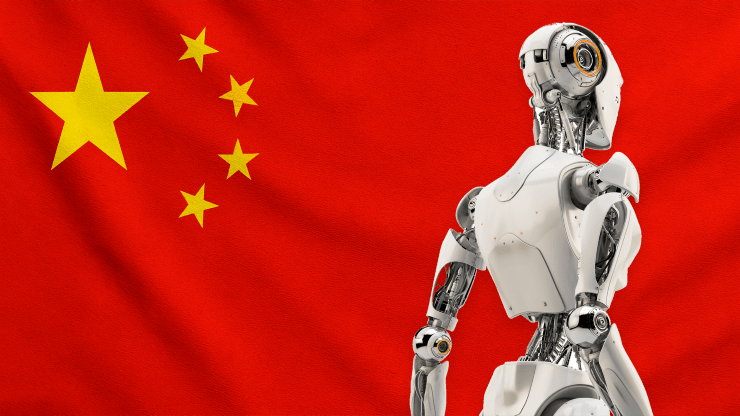
If robots can now dance and perform martial arts, what else can they do?
Unlike AI models or industrial equipment, humanoid robots are highly visible examples of China’s technological leadership that general audiences can see on their phones or televisions.
While China and the US are neck-and-neck on AI, humanoid robots are an area where China can claim to be ahead of the US, particularly in terms of scaling up production
By the end of 2024, China had registered 451,700 smart robotics companies, with a total capital of $932.16bn. Major government projects such as Made in China 2025 and the 14th Five-Year Plan, have made robotics and AI key Beijing priorities.
Morgan Stanley projects that China’s humanoid sales will more than double in 2026; and Elon Musk has said he expects his biggest competitor to be Chinese companies as he pivots Tesla toward a focus on embodied AI and its flagship humanoid Optimus.
“People outside China underestimate China, but China is an ass-kicker next level,” Musk said.
J. Michael Dennis ll.l., ll.m.
Based in Kingston, Ontario, Canada, J. Michael Dennis is a former barrister and solicitor, a Crisis & Reputation Management Expert, a Public Affairs & Corporate Communications Specialist, a Warrior for Common Sense and Free Speech. Today, J. Michael Dennis help executives and professionals understand, evaluate, and responsibly deploy AI without hype, technical overload, or strategic blindness.
Contact
jmdlive@jmichaeldennis.live

 J. Michael Dennis ll.l., ll.m. Live
You must be logged in to post a comment.